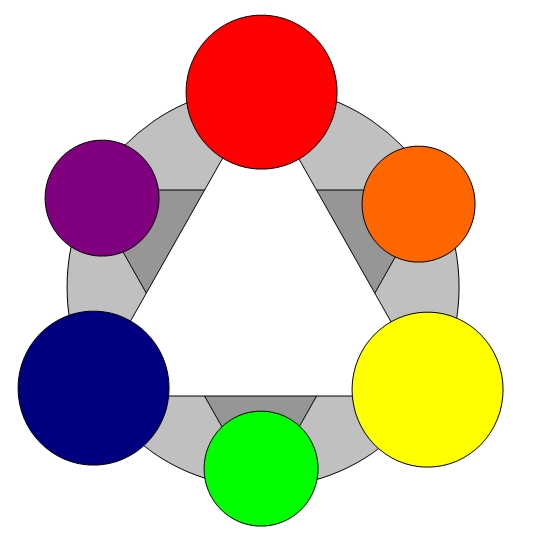
In colour mixing for painting, the fundamental rule is that there are three colours that cannot be made by mixing other colors together. These three, red, blue, and yellow, are known as the primary colours.
If you mix two primaries together, you create what is called a secondary colour. Mixing blue and red creates purple; red and yellow make orange; yellow and blue make green. The exact hue of the secondary colour you’ve mixed depends on which red, blue, or yellow you use and the proportions in which you mix them.
Colour mixing gives you a range of colours with a minimum number of tubes of paint (very useful when painting outside your studio). But you’ll find that there’ll always be an instance when the colour you want simply doesn’t come ready-made, such as a particular green in a landscape. Your knowledge of colour mixing will enable you to adapt a ready-made green to the shade you require.
The advantage of buying a premixed colour is that you are assured of getting the identical hue each time. And some single-pigment secondary colours, such as cadmium orange, have an intensity that’s hard to match from mixed colours.
 Jons Watercolours